
In this class assignment, future teachers (my students) watch three videos and write reflections in 35 words or less stating what they want for your children.
Dr. Panagos
In this class assignment, future teachers (my students) watch three videos and write reflections in 35 words or less stating what they want for your children.
Dr. Panagos
My name is Courtney Dotson and I’m a senior at Lindenwood University and member of the Council for Exceptional Children. I have always wanted to be a teacher and decided that Special Education was my calling because of my brother.
Edwards, C. C., & Da Fonte, A. (2012). The 5-point plan fostering successful partnerships with families of students with disabilities. TEACHING Exceptional Children, 6-13. Retrieved from http://cec.metapress.com/content/gj2612x4j40rr085/fulltext.pdf
Teachers play a very important role in the lives of all of their students. However, families know the children best and we need to remember this as educators. We will only have them in our classrooms for a short period of time in their lives. Their own families will be in their lives forever. We need to work close together with our students’ families and have them be involved in their educational progress. Nowadays intensive family planning and collaboration is usually only seen at the early childhood level. Special educators need to partner with families in all grade levels in order to benefit everyone that is involved.
This article gives teachers a five point plan of strategies to use when dealing with families of our students that have disabilities. Teachers should act as support for the family in order for them to establish their own goals and for them to not depend on the teacher to achieve these goals for them. The first point is to be positive, proactive, and solution oriented. Teachers should always focus on the positives and the accomplishments of their students. Families do not want to hear only the negative things about their children. Ask the family questions about the children. They know them best, after all. It will make the family feel like you care about their child and really want them to succeed because you are showing interest in them. I love the idea of calling a student’s family and asking them to tell me about their child. You will learn so much more about your students doing this as opposed to just reading a file about them. This will also build your relationship with the family. The second point is to respect families’ roles and cultural backgrounds in their children’s lives. Teachers need to give families the opportunity to make decisions but also need to be able to support them if they need it. Different cultures will have different feelings on this and we need to take this into account. We also need to remember if families need any interpreter services during any meetings we have. The third point is to communicate consistently, listen to families’ concerns and work together. Teachers need to be in constant communication with their student’s family. We need to share important information about their child and any progress that is shown. Families worry about their students and want to know what is going on when they are away in school. I like the idea of informing families when you will be able to talk with them beforehand so you don’t have any problems communicating and no one will feel like their voices aren’t being heard. Point four focuses on considering simple, natural supports that meet the individual needs of our students. Ask families what they do at home and if possible use these supports in the school setting. We need to discuss different modifications we want to use with the students and see how the family feels about it. The last point is to empower families with knowledge and opportunities for involvement in the context of the students’ global needs. The article states that families of students who have disabilities, feel isolated and cut off from their school and community. Ask the family what supports they might need and don’t assume you know what is best for them. You can also remind families about different functions and activities that are occurring in the school so they feel included. I really like this idea. I think every teacher should do this because we want everyone to feel like they are welcomed. I would love to see all of my students participate in school activities.
I firmly agree that the inclusion and involvement of a students’ family will benefit the student in a school setting. Every teacher should incorporate the family into their student’s school life.
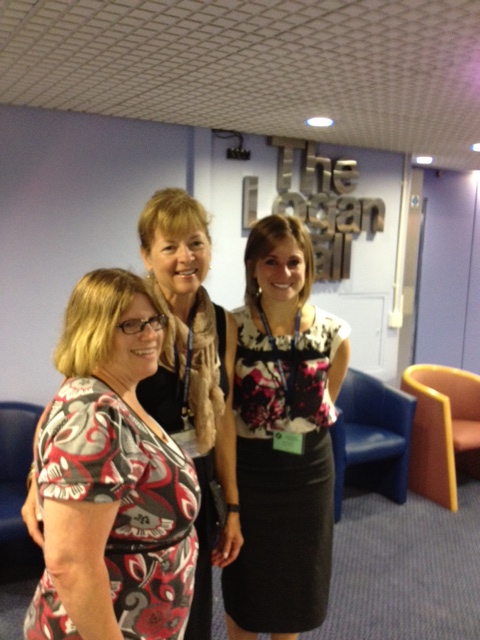
Kelly Hantak, Maria Lindsay, and myself at Logan Hall, Institute of Education, University of London
Presenting at the Institute of Education at the University of London, the impact of technology on globalization became a reality. United Services Early Intervention Coordinator Kelly Hantak and Lindenwood graduate student and early childhood special education teacher Maria Lindsay and I co-presented at The 19th International Conference on Learning. Titled “A Theory to Practice Model: Clincial University School Partnerships to Prepare Early Intervention Specialists”, Maria, Kelly, and I shared our paper and various perspectives as graduate student, child development therapist, and university professor. Utilizing a case study approach, we related theory taught jointly by therapist and professor to the graduate student’s perspective of contextual learning during home visits. Currently in press, the paper is scheduled to be published in next few months. Numerous conversations continue through email with colleagues from England, Greece, and the U.S. Follow this link for more information on The 19th International Conference on Learning.
This month I’m featuring topics in Recommended Practices for EI Specialists of Families of Young Children who have VI, Promoting Play and Visual Behaviors and Skill Development. Cathy Smyth, TVI, M.S. of Ed. Teacher of students with Visual Impairment, Anchor Center for Blind Children, has agreed to re-run a feature question and answer session from my class Intro. to Family Centered Practices Class.
Question: Cathy, please introduce yourself.
Answer: I currently work as an itinerant home visit Early Interventionist for Anchor Center for Blind Children throughout northern Colorado. I received my B. S. of Ed in Special Education with a specialization in Visual Impairment (Birth to 21) at Illinois State University, and have a Master’s degree in Early Childhood Education (Birth to 9) from Nazareth College in Rochester, New York. My professional background includes providing services to children with visual exceptionalities in all possible settings, including home visits, itinerant services at community-based preschools and daycares, inclusive public school K-12 settings and specialized center-based programs. I have worked at Anchor Center for eleven years in the Preschool, Infant/Toddler program and now, Home visits.
I have recently begun pursuing my Doctorate in Special Education (2008) with a concentration in Research at the University of Northern Colorado. My research interests include feeding/eating development in young children with visual impairments, early concept development and appropriate assessment of students with visual impairments.
Question: Please share with us your work on imaginative play for very young children with visual impairments.
Answer: Smyth, C. (2010, Fall). Imaginative Play. TX Senseabilities, 4(3), 18-20.
Imaginative Play
“When will my child be interested in the dollhouse her Grandfather made for her?”
“My other daughter loved to dress up like a princess at this age.”
“My son talks to his father on the phone, but if I give him the toy phone, he won’t talk!”
Imaginative play or symbolic play includes many levels of understanding. Children must have a clear understanding of what an object represents in real life before they can learn how to represent an object in play. Imaginative play is acquired in sighted children through imitation… they watch their parents and siblings do chores around the house and to be like them, they imitate sweeping, washing dishes, mowing the lawn, etc. Children identify characters in books and real life community members through the clothing they wear and the roles they play. Vision allows children to make connections between the firefighter, the red truck and the fire station down the street. The differences between animals on the farm are obvious from a visual standpoint. The back of the school bus is very different in shape and purpose.
A child with a visual impairment requires real-life experiences and many opportunities to practice pretend play before they can master these complex tasks. Introducing the skills of imaginative play is an exciting and rewarding process for families and early interventionists.
Types of Imaginative Play
Using Everyday Objects
The simplest type of imaginative play is pretending with everyday objects. Children talk on the phone, drink out of an empty cup, and push the buttons on the remote. In order to understand that they can pretend to engage in these activities, young children with visual impairments must have experiences with how the real objects work. This requires many repetitions of first tactile exploration of the object, direct instruction on how to interact with the object, and finally hearing the language that is involved with using the object. For example, talking on the phone involves the motor and tactile skills of pushing the buttons to make a call or to answer, holding the phone to the ear to hear the person on the other end, and a very specific vocabulary. The motivation to use these everyday objects is the feedback the child receives such as hearing Grandma’s voice, having a drink or finding their favorite musical show on the television. In pretend play, children do not receive this feedback. They must move past the simple cause/effect response in understanding the benefits of imitating others through social interaction.
Routines of the Day
The next level of imaginative play involves imitating routines experienced around the home by the child every day. Usually children will start to pretend activities that they like to participate in such as taking a bath, helping a parent take laundry out of the dryer, or even feeding a doll a bottle. Parents can encourage this kind of pretending by providing real-life “props” such as a small basket with a washcloth, a spray bottle and maybe a favorite toy that is used only in the bath. Children that love bath time can be seen washing themselves with the washcloth, singing bath time songs and lining up small toys like rubber ducks that have been sprayed with water. Only when children with visual impairments understand all the concepts and actions in a routine will they be ready to act out the routine as pretend play.
Using a doll or a stuffed animal in a pretend play routine is a higher level of understanding. The child must understand that the doll represents a baby, or even themselves. Children with sight learn this connection quickly through incidental learning, but children with visual impairments must participate in routines with the doll and hear their parents or caregivers interact with the doll as well as themselves. Again, this representative play involves processing the activity and the language over many repetitions.
As children become more familiar with using everyday objects to represent routines, this play can become increasingly complex. Parents are encouraged to provide a drawer or a cabinet in the kitchen where their child can explore safe kitchen items and participate in mealtime preparation. Stirring, fitting lids to pots and pans and nesting measuring cups are all motivating learning tasks that help relationship concepts develop as well as allowing children to experience family routines. This symbolic play can be expanded later to include setting a child-sized table for dolls or family members and serving tea and cookies. Of course, cleaning up should be part of the play process!
Dress Up Play
Pretending to be someone else in play requires understanding the characteristics and roles of others. It will be easier for a child to pretend to be someone they are exposed to everyday like their parents, rather than a firefighter or a ballerina, that they may never have met or experienced. Providing an area in the house where a child with visual impairment can imitate the tasks of others like a small table in the kitchen or a desk with a small writing center will encourage the child to be “just like mommy or daddy” in their everyday routines. Another motivating activity is to encourage your child to pretend to be like a family pet, allowing them to drink from a small dish on the floor or going for a “walk” in the backyard. Talking about wearing a hat like a favorite character in a book will allow your child to understand that these differences are exciting and it is fun to pretend to be someone else sometimes! Different clothing identifies community members to others, and the child with the visual impairment will need to be introduced to these differences through touch and experience. Practicing these skills at home will give your child confidence in the dress up corner at preschool where very important social skills develop between children.
Schema play
The next step in using representational objects through play is to understand that small figures and objects can imitate the activities of real people. This “schema” play includes little people in a school bus, construction workers and trucks in the sandbox or a dollhouse. This is a complex activity for children with a visual impairment, as they must understand the experience in real life. Many field trips to the farm that include touching, hearing and smelling the animals and equipment will give meaning to pretending that the chicken figure has laid an egg or the farmer is feeding the cows. A ride on a school bus and exploring all the parts like the seats or the door will assist children with understanding why the driver says “Move on back” and the small people move toward the back of the toy bus. If a child has sight, the “back of the bus” is an easy concept to attain through vision. A child with vision impairment needs to walk to the back of the bus, feel what is different about the back of the bus, use language to process the differences and then generalize that knowledge to the small toy bus. This may take many experiences and direct interventions before the child can independently play with a toy bus using pretend play.
Participating in imaginative play activities is a complex task for the young child with a visual impairment. It is necessary for the child to understand the purpose of the real object or the role of the actual person before they can begin to engage in representative play. The best way to achieve strong concept development and language use in imaginative play is through repeated real-life experiences and practice in a safe environment.
Catherine A. Smyth
Teacher of Students with Visual Impairments
Anchor Center for Blind Children
2550 Roslyn St.
Denver, CO 80238
cathysmyth@yahoo.com
My Play Home App. – iPad/iPhone/iPod touch – Cost $2.99
What a truly amazing app. for children of all ages! This app. features six different scenes within a home setting for kids to use their imagination to set up how they see things in a home. The amazing graphics and real life sounds this app. has to offer make it a favorite among all four of my children of all abilities ranging from ages 2 all the way up to 10! This is an excellent way to work on language skills, answering wh questions, labeling and the routines of self-help skills! It gives the opportunity of being creative and even silly at times. Well worth the $2.99!
This is a blog dedicated to learning more about Early Interventions (young children age birth to 3 years old) in Autism and Sensory Impairments (Visual Impairments and Deaf/Hard of Hearing). As professor of Family Centered Practices in the Early Interventions program, I am hosting a conversation among experts, researchers, professors, universtiy students and parents in the field of autism and sensory impairments. It is my hope that early intervention specialists will also join this on-going conversation and offer insight and advice from professional experiences to graduate students who may be new to the field of Early Interventions.
Here are the topics that we will be discussing for the next two weeks include but are not limited to:
Looking forward to following the conversation!
rpan52
 Early Interventions